How to Play D&D Alone (Actually)
No group, no problem. An honest survey of every real way to play tabletop-style adventures solo — oracles, journaling games, solo modules, and AI story games.
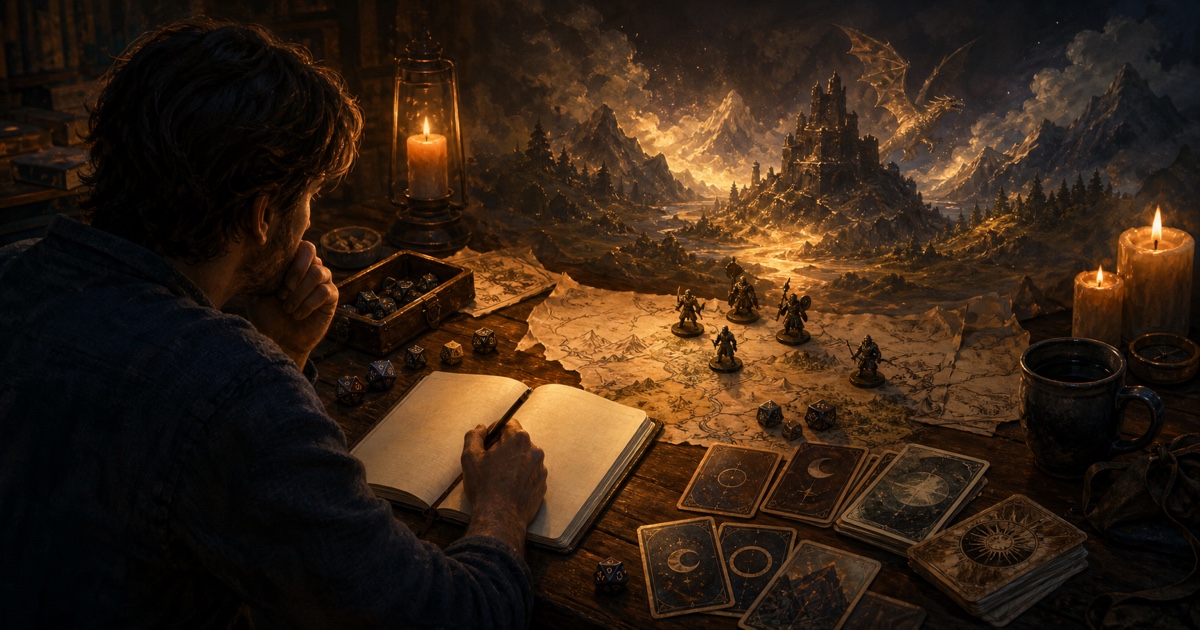
It is nine o'clock on a weeknight. The itch is specific: you want a dungeon, a decision, a die roll that matters. You do not want to schedule anything. The group chat has been negotiating a session date for three weeks, and tonight you would like to actually play. So you type the question thousands of people type every month: how to play D&D alone. Is that even a real thing, or a contradiction in terms?
It is real. You can play D&D by yourself tonight, and there are four honest ways to do it: oracle tables that answer your questions with dice, journaling games that turn play into writing, published solo adventures that pre-author the branches, and AI story games that put a responsive narrator on the other side of the table. Each method trades something away — surprise, momentum, freedom, or tactility — and knowing the trade is how you pick the right one for the mood you are in right now.
That is the whole article, honestly. The rest is the detail you need to choose.
How to play D&D alone: the four real methods
First, clear away the false premise. The rulebooks assume a group not because solitude breaks the rules but because the game's engine is a conversation: someone describes the world, someone declares an action, and the world responds. Every solo method is an answer to one question — who plays the other side of the conversation? Dice can do it. A book can do it. Your own pen can do it. Software can do it. None of these is a lesser version of the "true" game. They are four different instruments playing the same tune, and people have been playing solo this way for decades, since long before anyone put a story engine on the internet.
A note on scope before the survey: everything below works whether you are running an actual fifth-edition sheet or just want that tabletop feeling — exploration, consequence, a world that pushes back — without any rules at all. Most solo players drift toward the second thing over time. The rules were always scaffolding for the story.
Method one: oracle tables — dice as your game master
An oracle is a table you roll on to answer questions the rules cannot. You ask, "Is the door locked?" and the dice say yes, or no, or — the magic result — yes, but. The best-known engine is the Mythic Game Master Emulator, a slim system that has quietly powered solo tabletop play since the early 2000s; Ironsworn builds a full game around the same idea, with oracles for names, places, twists, and troubles baked in.
Here is what a session actually looks like. You frame a scene: your ranger approaches the abandoned watchtower at dusk. You ask the oracle a question with a probability attached — likely the tower is empty — and roll. The dice say no. Not empty. You roll on an encounter table, get "desperate stranger," and suddenly there is a deserter hiding in the stairwell with a story you have to improvise. You did not plan him. The dice planted him, and now you both have to deal with each other.
The trade: oracles give you genuine surprise — the thing solo play supposedly cannot have — at the cost of speed and texture. You are the interpreter of every roll, so the game moves at the pace of your own rulings, and every answer arrives as a terse abstraction ("yes, but") that you must dress in prose yourself. Some nights that authorship feels like power. Other nights it feels like doing two jobs. If you love the machinery of games, start here.
Method two: journaling games — the story as artifact
Journaling games flip the frame: instead of playing a session and remembering it, you write the session, and the writing is the play. You draw a card or roll a die, get a prompt — "You lose something you swore to protect; record what it was" — and answer it in your character's voice, in ink, in a notebook that slowly becomes an object. Thousand Year Old Vampire is the famous one, a game about centuries of memory and forgetting that has made a startling number of players cry alone at their desks. Ironsworn straddles this method and the last one; many games do.
The trade: journaling games produce the deepest interiority of any method — you will know your character better than any party ever knows theirs — at the cost of momentum and mechanics. There is no combat to win, little to optimize, and the blank page waits for you the way blank pages do. On a night when you want event, a journaling game can feel like homework. On a night when you want feeling, nothing else comes close. If part of why you play is that you love books, this method was built for you.
Method three: published solo adventures — the pre-authored path
The oldest method, and the coziest. Fighting Fantasy paperbacks, the classic numbered-paragraph gamebooks, and modern solo modules written for current rule sets all work the same way: an author has already imagined the branches, and you navigate them. Read paragraph 1, choose, turn to paragraph 247, fight the thing, turn to paragraph 12. Some modern solo adventures are sophisticated enough to track flags, inventory, and consequences across chapters.
The trade is the obvious one: you get an author's polish — real prose, fair puzzles, a plotted arc with an actual ending — and you surrender freedom. The branches that exist are the branches that exist. Ask a question the author did not anticipate and the book stares back. You also cannot replay one with clean hands; once you know where the trap is, it is not a trap. But as a way to spend tonight, right now, with zero setup and zero improvisational burden, a good solo adventure is unbeatable. It is the frozen dinner of solo play, and sometimes a frozen dinner is exactly correct.
Method four: AI story games — a narrator who answers back
The newest method restores the thing every other method simulates: the other side of the conversation. In an AI story game, you type what you want to say or do — in your own words, not from a menu — and a narrator responds, in prose, to that, specifically. Ask the question no author anticipated and you get an answer. Try the plan the oracle has no table for and the world reacts. It is the closest solo play comes to the feeling of a live game master improvising across the table, which is why it has become the default answer to "solo D&D online" — and if you want the deeper version of that comparison, we have written a whole essay on playing tabletop-style adventures without a game master.
The honest trade: you give up tactility and total authorship. There are no physical dice in your hand, and the narrator — not you — decides how the world answers, which is precisely what makes it surprising and precisely what oracle purists dislike. The method also lives or dies on one question: does the story remember? A narrator who forgets the deserter you spared early in the story is just a slot machine with good prose. Continuity is the entire difference between a story and a session of disconnected scenes, which is why it is worth understanding how memory works in AI story games before you commit an evening to one.
Where Runebook fits, and how to pick tonight
Runebook is our version of method four. It is an AI story game — not D&D, no rulebook required — where the Storyteller runs the world and you act by typing what you say or do, accepting a suggested action, or speaking it aloud. The story remembers what matters: the promise you made, the stranger you spared, the name you chose for your sword. Scenes come with narration read aloud and imagery, you can play solo or bring friends into the same story, and it runs in your browser. If the dungeon itch is specifically a fantasy itch, the fantasy adventure stories are the natural first door — though mystery, horror, romance, and stories built from your own idea are all standing open.
So, tonight: if you want machinery and authorship, print an oracle and roll. If you want interiority, open a notebook. If you want polish with zero effort, crack a solo module. And if what you actually miss is the conversation — a world that answers when you speak — then that method is one tab away. Create an account and start your first story — it's included. Start your story and see who is hiding in the watchtower.