Why Persistent Memory Changes Everything in AI RPGs
Persistent memory turns AI roleplay from disconnected scenes into campaign history: NPCs remember, factions react, and choices keep mattering.
Why Persistent Memory Changes Everything in AI RPGs
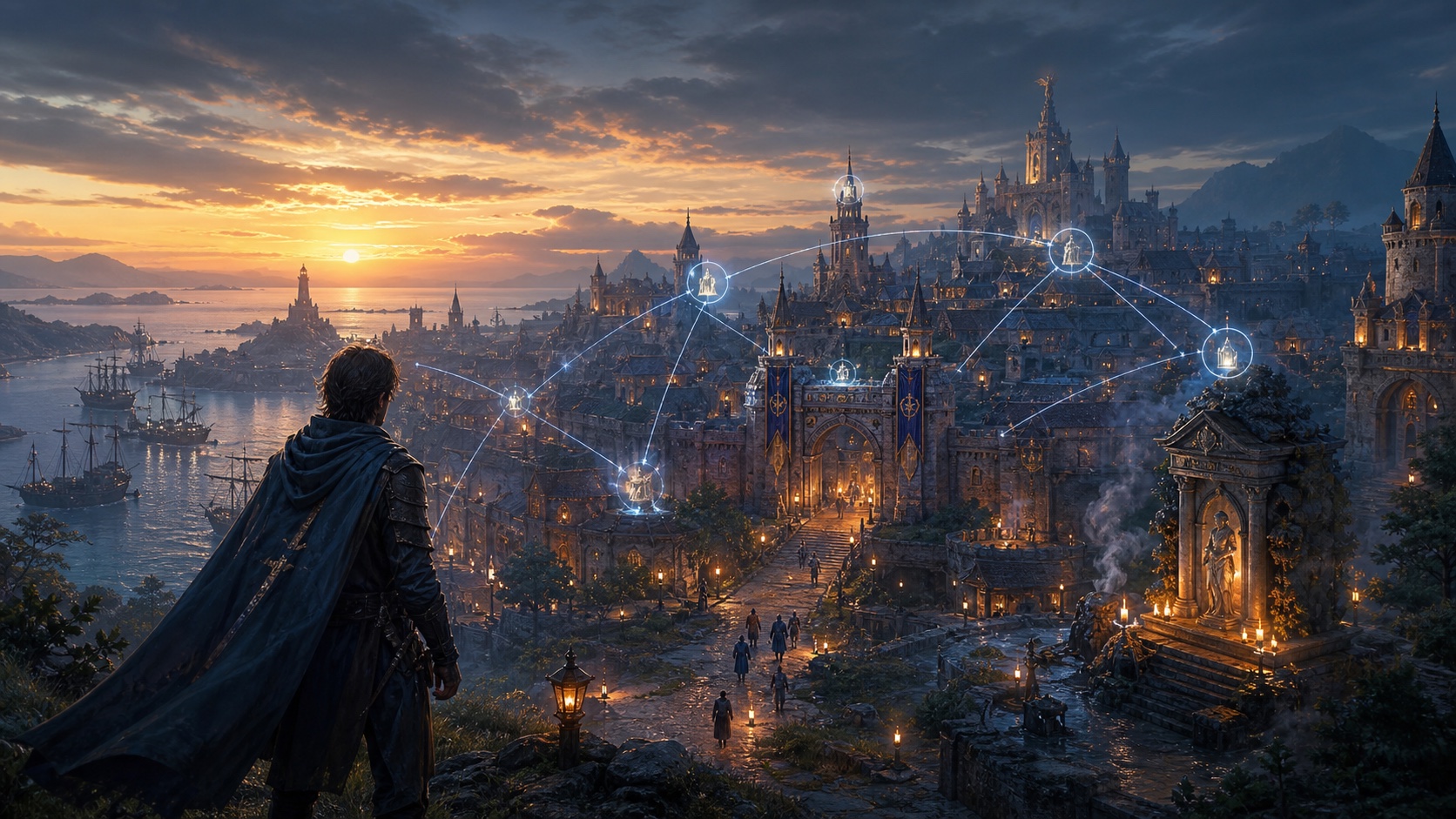
You return to Ashenmere after three real-world weeks away from your campaign. The dockmaster does not greet you like a generic quest dispenser. He greets you like the person who still owes his cousin seventy silver from the flood evacuation.
The eastern gate now flies the colors of the Iron Lanterns because you helped them break the tax guild's hold on the district in session two. The harbormaster's clerk, once neutral, has turned openly hostile after learning you forged customs papers under his nose. The shrine still has smoke damage from the night you decided a locked door was less of an obstacle than a suggestion.
That is what persistent memory feels like when it works.
The world did not just save your transcript. It kept the receipt.
Most AI storytelling tools are impressive in the first five minutes. They can describe a ruined tower, improvise a suspicious innkeeper, and make a goblin ambush sound dramatic. The problem shows up later. The villain forgets why they hate you. The city resets. The NPC who swore loyalty acts like a stranger. Your inventory becomes negotiable. The world still sounds fluent, but it has stopped being accountable.
That is the difference between an AI story generator and an AI RPG campaign.
The Short Answer
Persistent memory is what turns AI roleplay from disconnected scenes into campaign history.
A real memory layer lets an AI RPG preserve NPC relationships, world state, inventory, quests, faction pressure, character progression, and unresolved consequences so later scenes can respond to what actually happened.
Without memory, an AI can generate the next paragraph.
With memory, it can run the next session.
What Players Mean When They Say "The AI Forgot"
Players often describe memory failure without using technical language.
They say:
- "The AI forgot my companion existed."
- "The town reset when I came back."
- "The villain stopped acting like himself."
- "It forgot I stole the key."
- "My choices stopped mattering."
- "The campaign got mushy."
Those are not separate problems. They are all forms of the same failure: the system is no longer preserving the campaign's reality.
In a tabletop RPG, memory is everywhere. Your character sheet remembers your build. The map remembers where the dungeon is. The party remembers who betrayed whom. The DM remembers that the baron smiled when you lied to him because he already knew the truth. Even when nobody says "memory system," the entire game runs on remembered state.
AI RPGs need the same thing.
If an AI Storyteller cannot remember your promises, wounds, enemies, gear, allies, lies, and consequences, then the campaign eventually becomes decorative improvisation. It may still produce good lines. It may still be fun for a while. But it cannot create the feeling that you are living inside a world that has been changed by your presence.
Context Is Not The Same As Memory
One of the most common misunderstandings in AI storytelling is the idea that a bigger context window solves campaign memory.
It helps. It does not solve it.
Think of conversation context as a desk. You can spread current notes across the desk and do useful work while they are visible. But as the campaign grows, the desk fills up. Old papers get pushed aside. The model may still sound confident, but confidence is not continuity.
Persistent memory is the archive behind the desk.
It is where campaign facts can be stored, organized, retrieved, and used later because they still matter. The point is not to remember every sentence. The point is to remember the right facts at the right time.
That distinction is crucial. A good campaign memory system should not dump every old detail into every scene. That would feel noisy and strange. It should know when a detail is relevant.
The blacksmith does not need to mention her rescued son every time you buy arrows. But if her son is arrested by the same faction you once helped, the old rescue should matter. The priest does not need to repeat your confession in every conversation. But if you ask for sanctuary after betraying the temple, he should remember enough to hesitate.
Memory is not trivia storage. It is relevance under pressure.
What An AI RPG Actually Needs To Remember
The useful question is not "can the AI remember words?"
The useful question is: what categories of campaign state remain alive?
1. Character State
Your character needs to remain mechanically and narratively consistent.
Level, XP, stats, injuries, resources, equipped gear, spell use, and class identity all matter because they shape what kind of choices are possible. If you gained a level and improved your Dexterity, stealth scenes should feel different afterward. If you burned your last spell slot to survive a bridge ambush, scarcity should still be real in the next encounter.
Character growth only matters if the game remembers growth.
2. Inventory And Objects
Inventory is memory you can hold.
The forged signet ring, the ruby key, the cracked spyglass, the cursed sword you swore not to draw again, the half-empty healer's satchel - all of those only matter if they persist. A game that forgets your items is not only losing bookkeeping. It is losing future possibilities.
The best campaign objects are not props. They are unresolved promises.
3. NPC Relationships
This is where AI campaigns start to feel personal.
The blacksmith who gave you a discount after you rescued her son should not greet you with generic shop dialogue ten sessions later. The captain whose scouts you abandoned should not treat you like a clean slate. The rival you spared should not disappear into the mist unless the world has a reason for that disappearance.
NPC memory turns characters from response machines into people with history.
4. Faction Standing
Politics is memory at scale.
If you expose the pearl syndicate in public, the syndicate should not respawn as a neutral vendor faction. It should retaliate, retreat, fracture internally, or try to buy you. If you repeatedly work for the city watch, smugglers should treat you differently. If you betray a rebel cell, future rebels should not hand you sensitive missions because the prompt needs a quest giver.
Faction memory is what makes a world feel larger than the current room.
5. Quest State
A quest should not vanish because you closed the tab for a week.
If you promised to escort a fugitive priest to safety and then abandoned him when the guards closed in, that unresolved choice should stay unresolved. The game should remember not only that the priest exists, but that you failed him, and that someone else may now know.
Quest memory is not a checklist. It is the campaign's unfinished business.
6. World State
World state is where the setting proves it can change.
If you help one faction seize a district, blow up a smuggler tunnel, or reveal that a shrine is built over a buried crypt, the setting should reflect that. Roads open. Markets close. Rumors mutate. Guards move. Prices change. Enemies relocate. Pilgrims stop coming. People blame the wrong person.
Without world memory, every location is a stage reset between performances.
With world memory, places accumulate scars.
7. Consequences
Consequence is the point of all the other memory types.
The world should remember what you did in a way that creates new risk, new opportunity, and new emotional meaning. A remembered success should open a door later. A remembered failure should cast a shadow. A remembered lie should become dangerous when the person you deceived returns with better information.
That is what separates "the AI acknowledged my action" from "the campaign changed because of my action."
A Concrete Campaign Moment
Early in a Runebook campaign, you broker a winter-passage treaty between a border fort and the Ember Vale hunters after both sides nearly start a skirmish over grazing land.
The AI Storyteller calls for a Persuasion check. You get favorable context because you returned stolen medicine to the hunters in the previous session. The bargain succeeds as a real political outcome: the fort opens a supply road, and the hunters agree to guide caravans through the pass.
In a forgetful AI story, that moment ends when the paragraph ends.
In a remembered campaign, it keeps producing consequences.
Three sessions later, you return from a northern ruin and the road is still open. The quartermaster's prices have dropped because caravans are getting through. The hunters' sentries wave you past without testing your intentions. Then the next layer arrives: a rival baron has started sabotaging the route because your treaty shifted the region's balance of power.
The agreement, the people involved, and the changed political map all remain alive.
That is not just "an NPC remembered you." It is a world remembering your relationship to a deal, a region, and a chain of consequences.
Why Memory And Mechanics Belong Together
The first Runebook Journal post made the mechanics argument: AI RPGs feel better when actions resolve through game logic instead of prose vibes.
Memory is the second half of that argument.
Mechanics decide what becomes true.
Memory makes truth persist.
If you win a fight but the enemy's defeat does not change the world, the victory is thin. If you fail a Deception check but the lie has no future cost, the failure is flavor. If you gain a level but future scenes do not respect your growth, progression is cosmetic.
Mechanics without memory create isolated rulings.
Memory without mechanics creates vague continuity.
Together, they create campaign consequence.
What Good Memory Should Feel Like
Good memory should not feel like the game constantly reminding you that it has notes.
It should feel like pressure.
The guard at the gate pauses because he has seen your false papers before. The merchant lowers her voice because she knows which faction you angered. The old battlefield is quieter now because the army you helped route never returned. The priest refuses your donation because money is not the same thing as repentance.
The best memory moments are often small. A nickname returns. A scar is mentioned. A door is already unlocked because someone still trusts you. A rumor has your fingerprints on it. A rival chooses not to kill you because you once made the same choice.
That is when an AI RPG starts to feel less like a machine producing content and more like a world carrying history.
Where Runebook Fits
Runebook's core thesis is that AI storytelling needs more than a language model. It needs a campaign engine underneath it.
Runebook is an AI-powered storytelling RPG with 5e-style mechanics, persistent world memory, multiplayer support, and an AI Storyteller that turns natural-language actions into remembered campaign events.
The player should still be able to type freely. That freedom is important. But the world should not be free to forget.
If you bribe a guard, save a scout, steal a relic, expose a conspiracy, insult a faction leader, spare a monster, or abandon an ally, the campaign should have a place to put that truth. Not every detail needs to come back immediately. But the important ones should remain available when the story asks for them.
That is the promise of persistent memory in an AI RPG.
Not a smarter paragraph.
A longer shadow.
Why This Matters For The Future Of AI Storytelling
AI storytelling is easy to demonstrate and hard to sustain.
The demo is always the same: type something strange, watch the AI respond, feel the thrill of possibility. That thrill is real. It is also not enough. The future of AI RPGs will not be won by the system that can improvise the wildest paragraph once. It will be won by the system that can make the tenth session feel like it grew out of the first.
That is why persistent memory matters so much. It turns novelty into attachment. It turns events into history. It turns NPCs into relationships. It turns a map into a place you have damaged, helped, betrayed, and changed.
Players do not come back to a campaign because every line is perfect.
They come back because something they did is still waiting for them.
FAQ
Is A Bigger Context Window The Same Thing As Persistent Memory?
No. A bigger context window gives the model more current notes to read, but persistent memory is campaign state stored outside the immediate conversation and retrieved when it matters.
Context is the desk. Memory is the archive.
What Should An AI RPG Remember?
At minimum, an AI RPG should remember player characters, inventory, quests, NPC relationships, faction standing, world changes, unresolved promises, and important consequences from prior sessions.
The more campaign-like the product wants to be, the more memory has to become infrastructure rather than user homework.
Why Does Memory Matter For Player Choice?
A choice only keeps meaning if the world can remember it later.
Persistent memory lets consequences return as changed scenes, altered relationships, new risks, and opportunities that did not exist before.
Does Memory Mean The AI Should Remember Everything?
No. Remembering everything would be noisy and often useless.
Good memory is selective. It preserves the facts that can change future play: relationships, resources, locations, promises, conflicts, faction pressure, and world state.
How Is Runebook Different From A Chatbot With A Summary?
A chatbot summary can help, but it usually asks the player to maintain continuity manually.
Runebook's goal is to make campaign memory part of the game loop itself, alongside mechanics, quests, NPCs, inventory, factions, combat, and the AI Storyteller.
Ready for an AI RPG where choices persist? Start a Runebook campaign today.