Persistent Memory in AI Story Games
Persistent memory turns disconnected scenes into living history: people remember you, places carry scars, and choices keep producing consequences.
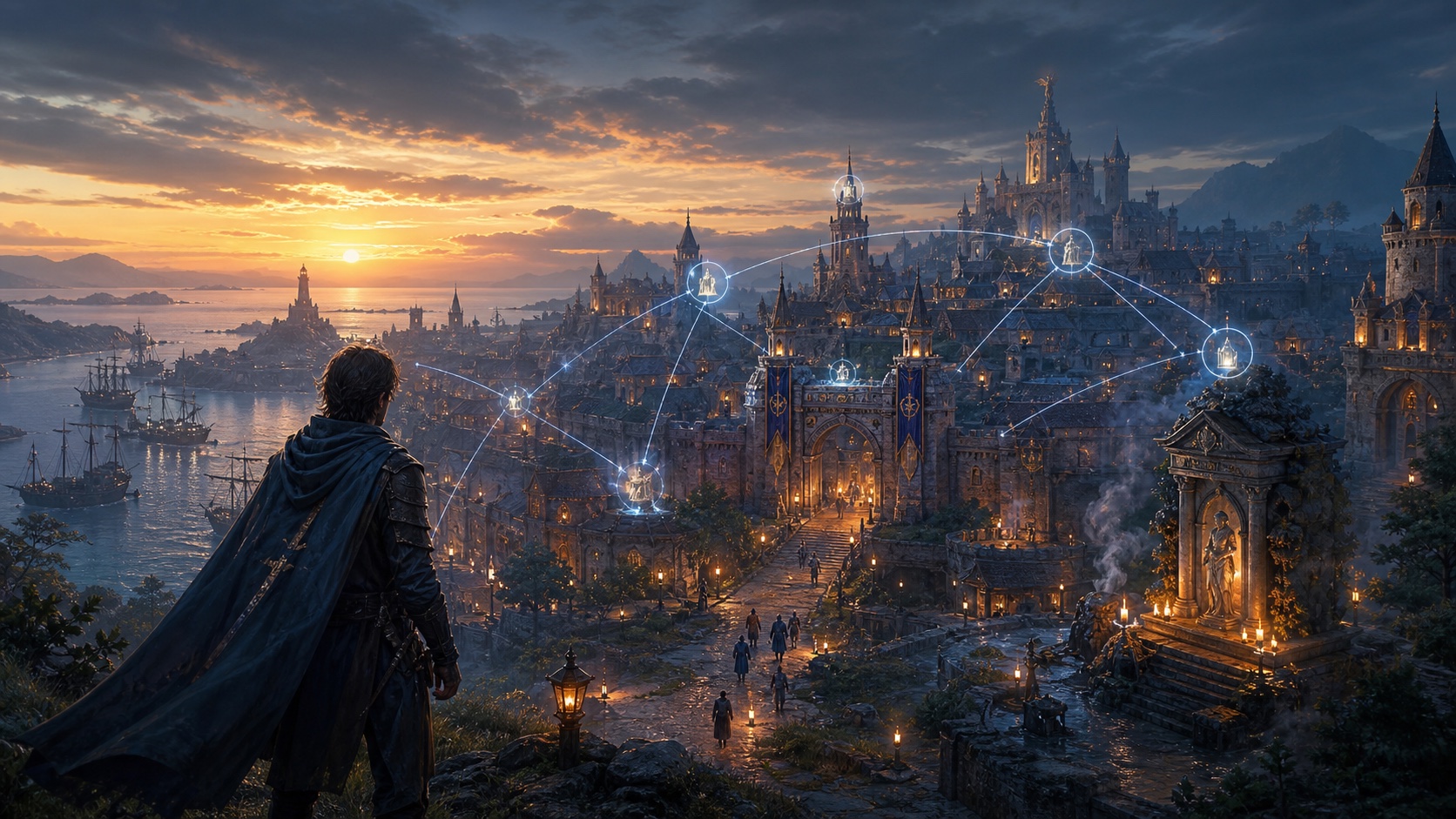
You return to Ashenmere after three real-world weeks away.
The dockmaster does not greet you with a stranger's politeness. He greets you like the person who still owes his cousin seventy silver from the flood evacuation.
The eastern gate now flies the colors of the Iron Lanterns because you helped them break the tax guild's hold on the district. The harbormaster's clerk has turned openly hostile after learning you forged customs papers under his nose. The shrine still has smoke damage from the night you decided a locked door was less of an obstacle than a suggestion.
That is what persistent memory feels like when it works.
The world did not just save your progress. It kept the receipt.
Many AI storytelling apps are impressive in the first five minutes. They can describe a ruined tower, improvise a suspicious innkeeper, and make a midnight chase sound dramatic. The harder test arrives later. Does the villain still know why they hate you? Is the city still changed? Does the friend who swore loyalty act like someone with a history?
Fluent scenes are not yet a coherent story. Coherence begins when the world becomes accountable to what already happened.
The short answer
Persistent memory turns an AI story from a sequence of scenes into a history.
Useful story memory carries forward the people you have met, the places you have changed, the promises you have made, what you carry, and the consequences still in motion. Later scenes can then respond to events that are no longer on the current page.
Without memory, a Storyteller can write the next paragraph.
With memory, it can keep telling the same story.
What players mean when they say “the story forgot”
Players rarely describe memory failure in technical terms.
They say:
- “My ally stopped existing.”
- “The town reset when I returned.”
- “The villain started acting like a different person.”
- “The stolen key disappeared.”
- “My choices stopped mattering.”
- “The story got mushy.”
Those complaints sound different, but they share a cause. The world is no longer preserving its own reality.
In any story worth finishing, memory is everywhere. The reader remembers a promise made near the beginning, which is why its breaking lands later. The detective remembers the alibi that no longer fits. A friend remembers the kindness that makes a later betrayal hurt.
Even when no one says memory, the story runs on remembered truth.
A bigger desk is not an archive
Holding more recent conversation helps continuity. It does not solve the entire problem.
Imagine the Storyteller's attention as a desk. Current pages can be spread across it while they are useful. As the story grows, the desk fills. Old papers slide underneath new ones. A confident voice can keep speaking even after the important page has fallen to the floor.
Persistent memory is the archive behind the desk.
The point of an archive is not to dump every old page back onto the table. It is to preserve what matters and return it when the present makes it relevant.
The blacksmith does not need to mention her rescued son every time you buy nails. If her son is arrested by the people you once helped, the rescue should matter. The priest need not repeat your confession in every scene. If you seek sanctuary after betraying the temple, he should remember enough to hesitate.
Memory is not trivia storage. It is relevance under pressure.
That is also the engine of a good detective story: mystery is memory under pressure. An alibi can crack only if the world kept the original story straight.
What an AI story game needs to remember
The useful question is not whether a system can retain words. It is which parts of the story remain alive.
Who you have become
You should remain recognizably yourself and still be changed by what happened.
The limp earned on the cliff road, the false name given to the ferryman, the reputation that reached the next town first, the lie maintained since the masquerade: these facts shape who enters the next scene. Becoming someone matters only if the story remembers who you were.
What you carry
What you carry is memory you can hold.
A forged signet ring, a ruby key, a cracked spyglass, the letter never delivered, the last dose in a healer's satchel—each can become a future scene. A story that forgets possessions is not merely losing bookkeeping. It is losing possibilities.
The best objects are unresolved promises.
The people who remember you
This is where an interactive story becomes personal.
The blacksmith whose son you rescued should not return to shopkeeper small talk. The captain whose scouts you abandoned should not treat you as a clean slate. The rival you spared may have changed, but the mercy should still belong to both of you.
Memory turns characters from response machines into people with history.
Where you stand with the world
Reputation is memory at scale.
Expose the pearl smugglers in public and they might retaliate, retreat, fracture, or offer a bribe. Keep helping the city watch and the smugglers should adjust. Betray one secret too many and the next person should hesitate before trusting you with theirs.
A world that remembers where you stand feels larger than the current room.
Unfinished business
A promise should not vanish because you closed a tab for a week.
If you swore to escort a fugitive priest to safety and abandoned him when the guards arrived, the choice should remain unresolved. Someone may have helped him. Someone may have seen you leave. Someone may now be waiting to collect the debt.
Unfinished business is not a checklist. It is pressure the story has not released.
How places changed
Places prove that a setting can accumulate history.
Help one side take a district, collapse a smuggling tunnel, or expose what lies beneath a shrine and the setting should answer. Roads open. Markets close. Guards move. Pilgrims stop coming. Rumors attach themselves to the wrong person.
Without memory, every location is reset between performances.
With memory, places keep their scars.
What your choices set in motion
Consequence is the point of every other kind of memory.
A remembered success can open a door later. A remembered failure can cast a shadow. A remembered lie can become dangerous when the person you deceived returns with better information.
That is the difference between the story acknowledged my action and the story changed because of my action.
A remembered choice changes more than one scene
Early in a story, you broker a winter-passage agreement between a border fort and the Ember Vale hunters. The hunters take your word seriously because you returned their stolen medicine. The fort opens a supply road. The hunters agree to guide caravans through the pass.
In a forgetful story, the scene ends when the paragraph ends.
In a remembered story, the bargain keeps producing consequences.
When you return, the road is still open. The quartermaster's prices have dropped because caravans are getting through. The hunters' sentries recognize you. Then the next consequence arrives: a rival baron is sabotaging the route because your agreement shifted power across the region.
The choice became an economy, a set of relationships, and a new danger.
Why memory gives a story shape
Memory keeps the past alive. Story direction gives it somewhere to go.
A responsive story should build on what you did rather than reveal a route written before you arrived. Pressure gathers. Unfinished business returns. Earlier choices change what becomes possible next. By the ending, the finale should belong to the history that produced it.
Direction without memory is a story with amnesia.
Memory without direction is a diary with no plot.
Together, they let choices become history. That is the deeper promise behind choosing your own story: not merely selecting what happens now, but living with what the selection makes possible later.
What good memory should feel like
Good memory should not feel like a story constantly announcing that it has notes.
It should feel like pressure.
The guard pauses because he has seen your false papers before. The merchant lowers her voice because she knows whose anger you earned. The harbor is quieter because the fleet you warned away never returned. The priest refuses your donation because money is not repentance.
The best memory moments are often small. A nickname returns. A scar is noticed. A door is already unlocked because someone still trusts you. A rival lets you walk away because you once did the same for them.
That is when an AI story game begins to feel like a world carrying history.
Where Runebook fits
Runebook is an AI story game built around the belief that freedom needs continuity.
You can choose a suggested action, type a different move, or say what you do. The Storyteller carries forward important people, places, possessions, promises, and consequences so the world can answer from its own past.
That does not mean remembering everything. Perfect recall would be noisy, intrusive, and often useless. The promise is more demanding: remember what matters when it matters.
If you bribe a guard, save a stranger, steal a relic, expose a conspiracy, insult the wrong family, spare an enemy, or abandon a friend, the story should have somewhere to keep the consequence.
Not a smarter paragraph.
A longer shadow.
FAQ
Is a longer conversation the same as persistent memory?
No. More recent text gives the Storyteller a bigger desk. Persistent memory is the archive that can preserve older story facts and return them when they become relevant again.
What should an AI story game remember?
It should preserve what can still change future scenes: who you have become, what you carry, the people who remember you, where you stand, unfinished business, changed places, and consequences already in motion.
Does good memory mean remembering everything?
No. Good memory is selective. It keeps the facts the story can still use without dragging every old sentence into the present.
Why does memory matter for choice?
A choice keeps meaning only if the world can answer it later. Memory lets consequences return as changed relationships, altered places, new risks, and opportunities that did not exist before.
Something you did is still waiting for you. Start your story.