What If Elizabeth Bennet Could Say Anything?
Pride and Prejudice already runs on choices, memory, and consequence. Let Elizabeth say anything, and the real question is whether her world can make it matter.
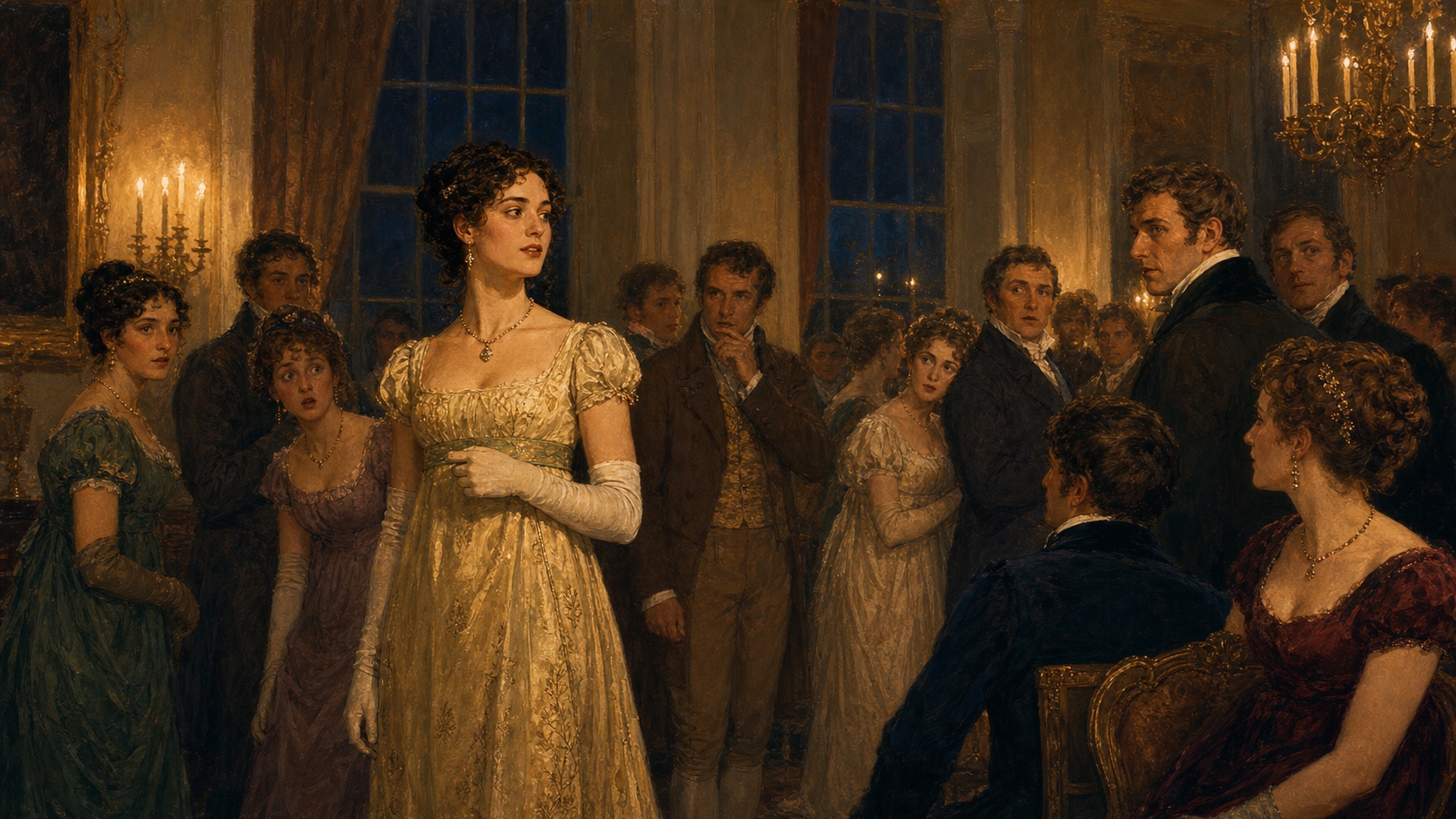
At a public assembly in Meryton, Elizabeth Bennet sits out a dance for lack of a partner and overhears a rich stranger decline to rescue her. "She is tolerable, but not handsome enough to tempt me," Mr. Darcy says, within her hearing, in the first act of Pride and Prejudice.
Here is what makes Elizabeth Elizabeth: she does not swallow it, and she does not make a scene. She turns the insult into a story. She retells it to her friends "with great spirit," making the proud man ridiculous in a room where the rumor of his ten thousand a year had made him untouchable.
Now imagine standing where she stood, in some interactive retelling. The menu appears. Laugh it off. Confide in Jane. Resolve to dislike him. All reasonable. All in character. And all already written by someone who anticipated this moment. But the thought you actually had was probably none of those: what if she turned around? Not a quip selected from three buttons. A remark that belongs to this woman, in this room, and is dangerous for reasons the room understands.
The answer is not that Elizabeth should be able to say anything. Austen never grants her limitless freedom. Elizabeth is compelling because she is unusually free inside a world that keeps score — and that combination, not the freedom alone, is what any story game worth playing has to earn.
Pride and Prejudice is already a game of consequences
Conversation in Austen is not decoration between important events. Conversation is where important events happen.
Money keeps the first set of books. The Bennet estate is entailed away to a cousin; five daughters will inherit almost nothing; every ballroom conversation happens in the shadow of that arithmetic. Charlotte Lucas — clever, clear-eyed, twenty-seven — marries the ridiculous Mr. Collins because the alternative is genteel poverty, and Austen refuses to pretend she chose wrongly.
Reputation keeps the second set, and reputation is simply the community's shared memory. Word of Darcy's fortune arrives at the assembly before he does. Wickham's slander works because gossip in Meryton is infrastructure — say a thing to one drawing room and you have said it to all of them. And when Lydia runs off, the cost lands on every sister's marriage prospects at once. One person's choice, distributed to the whole family ledger.
Manners keep the third: the compression that gives every word its charge. Precisely because so little may be said openly, everything said carries weight. A withheld dance is a statement. A too-warm compliment is a commitment. Speech is not decoration on the action. Speech is the action.
That is why Elizabeth's wit has force. She speaks before people who will remember the remark, repeat it badly, interpret it selfishly, or discover later that it exposed something true. Her freedom is measured by the resistance around it. Remove that resistance and the novel collapses into banter.
Saying anything is the easy part
Interactive stories often advertise freedom at the point of input: type whatever you want. The promise is exhilarating because it removes the visible menu. Instead of choosing between accept, refuse, and make a joke, you can make the offer yourself, leave the room, accuse the wrong person, or ask why everyone is pretending not to know the obvious thing.
But a blank page where the menu used to be solves only half the problem.
Suppose Elizabeth insults Lady Catherine and, one scene later, Lady Catherine behaves as if nothing happened. Suppose Mr. Collins receives a devastating refusal and returns with precisely the same proposal. Suppose Lydia's conduct changes no one's prospects because the story remembered the event but forgot the family as a social organism. Elizabeth would be able to say anything, and almost nothing she said would matter.
This is the central difficulty of a responsive story. Producing an elegant reply is not the same as understanding a consequence. A character can answer you beautifully while the world beneath the answer resets itself. The scene moves. The story does not.
Austen offers a sterner standard. Her people misremember, misunderstand, gossip, conceal, and revise. They do not need perfect recall. They need interested recall: each person remembers what touches pride, hope, embarrassment, money, affection, or fear. That is not a transcript of the conversation. It is a society.
Reputation is memory with an audience
In many adventure stories, continuity is easiest to see in objects and injuries. You still possess the key. The bridge is still broken. In a social story, the most important state may exist only in what one person believes about another.
Consider four invented moments in an original Regency story:
- You decline an invitation politely, but a witness decides your reason was contempt.
- You defend a ridiculous cousin when mockery would have won the room.
- You reveal a confidence to protect a friend, and the friend learns only that you revealed it.
- You make a joke at a gentleman's expense, and his sister repeats it as a declaration of war.
None of these needs a meter labeled reputation. Their consequences can live in altered warmth, missing invitations, dangerous confidences, unexpected loyalty, and the new meaning of an old remark.
The world should not remember everything. It should remember what matters to the people who inhabit it. One character may forget the precise words but retain the humiliation. This is how memory becomes drama rather than recordkeeping: the past survives as pressure on the present.
Romance lives on that pressure. Attraction in Austen is revision — the Pemberley chapters work because everything Elizabeth sees there argues with everything she has on file. The suitor who forgets he was refused is not a fresh start. He is a broken clock.
A branch is not the same thing as a choice
None of this is an argument against authored branching stories, which can be superb. A writer can tune each option to the protagonist's voice and make several paths feel inevitable only after you have chosen one. Austen herself did not need infinite versions of Elizabeth to create a heroine whose decisions feel free.
But a menu's ceiling is anticipation: every option is something the writer saw coming. Play long enough and you stop asking what would I do here and start auditing the list — inferring the intended route, choosing with one eye on the author. Surprise flows in one direction only, from the story to you.
In a responsive story, you can introduce a possibility no writer selected, and the challenge moves downstream: the story must decide what that action means here, who noticed it, what it disturbs, and which consequences deserve to return. The responsive form earns its freedom only when the unexpected choice becomes owned. The story cannot merely permit the action. It must accept the burden of it — and so must you. The difference between selecting a branch and owning a choice is the difference between reading about Elizabeth's courage and having to find your own in front of a full assembly.
Austen's world answers
There is one more reason unlimited self-expression is the wrong measure of an Elizabeth Bennet fantasy: Elizabeth is not always right.
She interprets Darcy through an injured first impression and Wickham through a flattering one. She refuses Darcy's insulting first proposal at Hunsford — an expensive choice; she is turning down security her family badly needs — and the refusal stays refused. It provokes the letter. The letter supplies facts, and Elizabeth is capable of letting facts reorder her, until she arrives at one of the most quietly devastating lines in English fiction: "Till this moment I never knew myself."
A weak interactive story treats player freedom as a command that the player must always be vindicated: every accusation proves true, every joke delights the room. The world bends so quickly that it ceases to offer anything back.
Austen's world answers. It meets Elizabeth's refusals with consequences, her misjudgments with evidence, and her honesty with the possibility of a more honest love. For a story game, that is the whole design principle in one sentence: the player should be free to surprise the world, and the world should be free to surprise the player.
An Austen-like story is not a copied Austen plot
There is an obvious temptation in asking what Elizabeth might do differently: turn the novel into a maze of alternate scenes. What if she accepts Mr. Collins?
Direct adaptations are entitled to explore that, and the current ones have real craft — they are working with recognition, the pleasure of walking a beloved plot from the inside. A responsive story can seek something else: an original young woman whose wit is useful and dangerous, an original household whose solvency depends on an ugly arrangement, an original circle of neighbors who mistake manners for morals. The pleasures of courtship, social pressure, pride, misjudgment, and earned intimacy — without borrowing Longbourn, Darcy, or Elizabeth's decisions.
The distinction matters artistically, not only legally. If everyone already knows which marriage must occur, the world is secretly protecting a destination. In a new social world, an ending can be romantic without being ordained.
The goal is not to improve Austen by making her interactive. It is to let Austen improve our idea of what interaction demands.
The story must know why the room went quiet
So — what if Elizabeth Bennet could say anything?
The interesting answer is not a catalogue of outrageous lines. It is a world sufficiently alert to know which line was outrageous, who was wounded, who was secretly impressed, who will repeat it at dinner, and why the speaker may understand it differently by morning. Speech becomes action. Reputation becomes memory. Social cost gives freedom its shape.
That framework reaches well past Regency romance. A detective's careless question can warn a suspect. A prince's mercy can look like weakness to one faction and courage to another. The genres change; the requirement does not. The player supplies possibility. The story supplies resistance, memory, and consequence. Somewhere between them, freedom acquires weight.
Enter a social world of your own
That combination is what Runebook is built for. It is an AI story game: you describe the kind of story you want to live in, a Storyteller runs the world and everyone in it, and you act by typing what you actually want to say and do. The story remembers what matters, and the people in it keep score the way Meryton kept score — start with an interactive romance where the choices carry, or any story where the path is yours to choose.
Start a story of your own — and mind what you say at the assembly. Someone will remember it.