Endless AI chat adventures
- What it gives
- Freedom to keep going
- What it misses
- Shape, pressure, and arrival
Most AI story apps can improvise the next paragraph. Runebook is built for the harder problem: making player freedom add up to a coherent story.
You step into a story as the protagonist. The Storyteller carries each scene forward, remembers what matters, and moves the story toward an ending shaped by what happened before.
A playable story engine.
Now in Early Access
Runebook is live for founding players. Choose a plan, then start playing in your browser.
Start your story free, no credit card required.
AI can already generate paragraphs. That is no longer the frontier. The frontier is whether a story can survive you: your freedom, your contradictions, your strange decision, your week away, your refusal to do what the obvious branch expected.
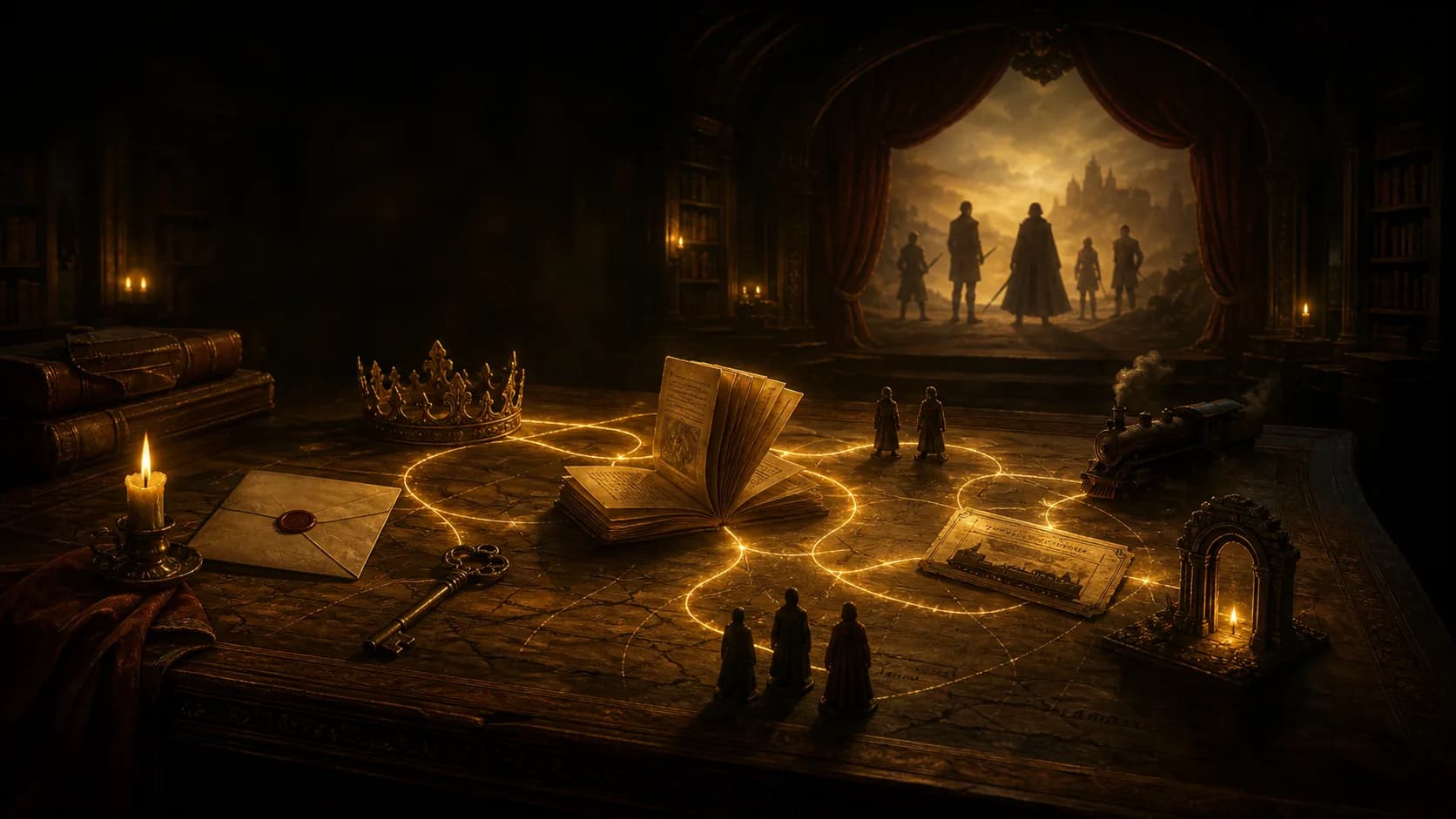
Runebook is not trying to generate infinite story text. It is trying to run a story: remembering what matters, shaping the story around the player, and guiding freedom toward an ending that feels earned.
Stories need shape. Players need freedom.
A satisfying story has pressure, secrets, reversals, memory, escalation, and payoff. A satisfying player experience asks for agency: the freedom to act in your own words, try the thing no writer predicted, and change the story because you were there.
That conflict is the narrative paradox: the tension between authorial control and player agency. Too much control, and the player becomes decorative. Too much unconstrained freedom, and the story dissolves into wandering, chat, or noise.
Most approaches still solve one side of the problem while leaving the other exposed.
The missing layer is not a better chatbot, more memory, a bigger branch tree, or more rules. It is a narrative engine.
More text is not the engine. The engine is the system that helps a story hold together while the player changes it.
The right detail returns when it matters.
Places carry the mark of what happened there.
People remember who you were to them.
Unfinished business becomes fuel.
The story moves, gathers weight, and changes shape.
The world pushes back instead of waiting forever.
Mystery, romance, horror, fantasy, and drama keep their pressure.
The finale answers the road that led there.
This is Runebook's approach to the narrative paradox: it does not choose between agency and structure. It makes agency part of the structure.
Choose, type, or say what you do.
The scene moves around your decision.
People, places, promises, and secrets carry history.
Small choices gather pressure over time.
The finale is shaped by what came before.
Four things people often confuse, and the difference that matters.
What it gives: Authored structure
What it misses: Freedom is limited to the paths that exist.
What it gives: Open agency
What it misses: The story can drift into an infinite middle.
What it gives: Responsive scenes
What it misses: Dialogue is not the same as story architecture.
What it gives: Agency plus story shape
What it solves: Built to hold both.

Imagine you start a historical drama in 1927 New York. A ledger is changing hands across the city. The Storyteller gives you several ways in, and you do something else: you send a warning to the one person everyone told you not to trust.
You warned someone dangerous.
The story keeps who you reached and what that implies.
The room changes before you arrive.
One door closes, another opens, someone moves first.
The first warning can still matter later.
When the system is working, you are not thinking about branches, systems, or machinery. You feel that the scene noticed you, that the world moved, and that what happens next carries pressure from what came before.
The Storyteller keeps track of what people know, what changed hands, which promise was made, what danger advanced while you hesitated, and which ending is now becoming possible.
Freedom you can feel. Structure you do not have to see.
Not a smarter paragraph.
A story that remembers.
A deeper pass for readers comparing AI story systems, interactive fiction, and the future of player agency.
An AI narrative engine is a story system designed to carry an interactive story forward. It is not just the part that writes prose. In Runebook, the narrative engine supports player agency, story memory, character continuity, unresolved threads, dramatic pressure, and endings shaped by what happened before.
The narrative paradox is the tension between story structure and player freedom. A story needs pacing, pressure, setup, payoff, and an ending that answers what came before. A player needs agency to feel like their choices matter. The hard problem is letting the player act freely without losing the shape of the story.
AI can help address the narrative paradox, but not by itself. A system that can continue text is not the same as a story engine. Runebook was built from the ground up to have a coherent narrative system design with a realistic consequence engine. We believe this is the right approach to a system that satisfies the narrative paradox.
AI Dungeon-style experiences are often built around open-ended sandbox freedom. Runebook is built around playable story: memory, consequence, rising pressure, narration, scene images, and endings shaped by your choices. The goal is not an infinite middle where the story keeps continuing because it can. The goal is a story that remembers and arrives somewhere. A story with a beginning, a coherent narrative, and a satisfying end.
Without memory, choices evaporate. Memory lets a story carry promises, betrayals, relationships, objects, places, and consequences forward so earlier choices can matter later. The important part is not remembering every fact forever. The important part is dramatic memory: the right detail returning at the right moment.
Coherence comes from continuity. People remember. Places change. Unresolved threads return. Pressure escalates. The ending answers what came before. A coherent interactive story can adapt to the player without forgetting what kind of story it is.
No. A chatbot centers on conversation. Runebook centers on story. The AI Storyteller carries scenes, characters, consequences, narration, images, and endings, not just the next message. A chatbot can give you a vivid exchange. Runebook is trying to make the exchange matter later.
Runebook is live in paid Early Access. Leave your email for product notes, Early Access updates, offers, and occasional notes on what we are building. No spam. Just stories.
Runebook gives you suggested choices to keep scenes moving, but those choices are not walls. You can type your own move or say it out loud. Accuse the wrong person, leave the room, confess too early, warn the enemy, or try the thing no menu offered. The Storyteller carries the story forward from what you actually do.
Endings are what separate a story from an endless stream. If a story never resolves, choices can start to feel weightless. Runebook is designed so the story keeps building toward an earned ending that remains coherent with the path the players create.
Authorial control is the force that keeps a story coherent: pacing, genre, stakes, escalation, and payoff. In traditional fiction, the author controls all of it. In an interactive story, too much control makes the player feel trapped. Runebook lets the player act freely while the Storyteller keeps enough story discipline for the experience to feel shaped.
Runebook is a story game. You are not opening a blank document and trying to author every scene yourself. You are the protagonist inside the story, making choices in plain language while the Storyteller carries the world, cast, pressure, narration, scene images, and story forward.
Runebook can begin from the same seed or opening, and some openings may have designed events to give the story a strong first shape. But where the story goes from there is based on the choices made by the protagonists, and no two players will ever see the same story. The important difference is what happens after you act: the Storyteller carries the story forward around what you actually did.
Yes. Runebook can run many kinds of stories: murder mystery, romance, horror, fantasy adventure, historical drama, and custom premises that mix tone, era, and setting. The engine preserves the pressure of the story you asked for while letting your choices change what happens inside it.
The story should not break because you did not pick the obvious option. If you accuse the wrong person, leave the room, warn an enemy, burn the letter, confess early, or wait too long, the Storyteller carries that action forward as story material.
Two players can start from the same seed but will never end up with the exact same story. Every story is generated around the player's actions or inactions, with randomness and varying prose involved. The opening premise may rhyme, but the alliances, betrayals, secrets revealed, people saved, risks taken, ending pressure, and final resolution should diverge as choices accumulate. Endings are dynamic too, based on how the protagonists choose to resolve the story.
A general chat app can help you improvise prose. Runebook is designed for a different job: running a playable story with a Storyteller, choices, typed or spoken actions, memory, narration, scene images, rising pressure, and endings. The difference is whether the experience understands that choices need consequences and that a story needs somewhere to go.
Yes. Runebook is solo-first, but stories can be shared with friends. The Storyteller carries what the group did, who said what, what changed, and how those decisions affect what happens next. Multiplayer should feel like everyone stepped into the same story, not like separate chats stitched together.